
Sitka spruce belongs to the family of Pinaceae. They are imposing trees with needle-like leaves and brown cones in autumn. In Britain, Sitka spruce is one of the most important tree species of the forest industry. They can also be found in Gosforth Nature Reserve, but here, the trees are cut down do make space for native species. Those new trees are planted by the backbone of the reserve: its volunteers.
James Common leads me to the site where volunteers are planting trees after our talk about the importance of Gosforth Nature Reserve. “We couldn’t do it without them,” James tells me when we arrive at the clearing. The sun has finally decided to come out. Volunteers are working alone or in pairs. First, they use shovels to make a hole in the ground before they put in a scrawny little branch that will grow into a tree.
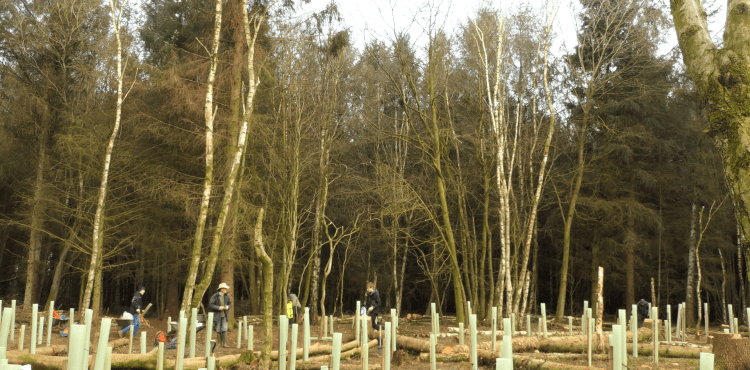
The area that has been cleared of Sitka spruce is open and bright in the sunlight, but in the background, the remaining trees loom over the site. I feel like Bilbo Baggins and the company of dwarfs when they stand in front of the forest Mirkwood on their way to slay the dragon. Sitka spruce is a very dark, shadow forming tree. The volunteers are planting a selection of native trees and shrubs to improve the diversity structure of the reserve.
“Our work parties are made up of everyday people, our members, students and they do several jobs from tree planting – today they’re hedge laying, they also build hides, sheds, invasive species control, building works, repairs – they do it all,” says James. Next to us, a woman in her thirties of forties stomps her feet on the ground next to one of the planted trees to stabilise it in the ground.
Just short of 20 volunteers have come to the reserve to help plant trees, which is a great turnout for a Saturday, tells me Clare Freeman. Clare is the director of the Natural History Society of Northumbria. “We have our Saturday conservation tasks monthly in winter,” explains Clare. “Today we plan to plant 250 trees.”
It’s very easy to become a volunteer at Gosforth Nature Reserve. “It’s as simple as emailing the office,” James tells me. “We welcome everyone to get involved and try our best to shape volunteer experience to someone’s personal interests. We are happy to accommodate volunteers from students to adults to older individuals. Just get in touch and we are happy to talk.”
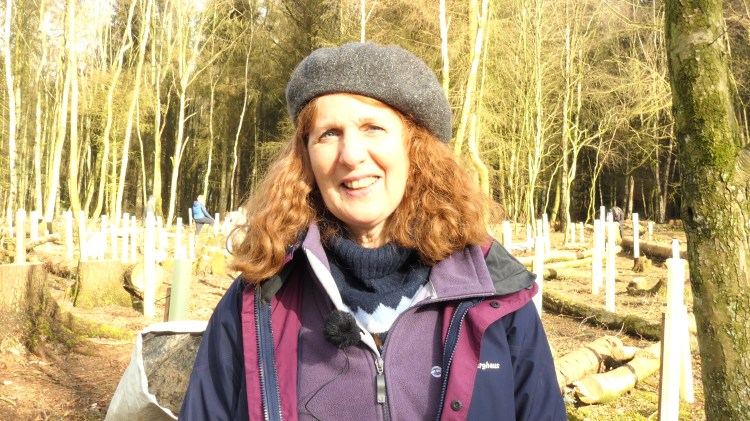
Not only seasoned volunteers have come to Gosforth to get their working boots dirty. For Catherine Waters from Newcastle, it’s the first time to volunteer at the reserve. “It’s absolutely beautiful. I love planting trees,” she gushes. “I think it’s a really beautiful site with lots and lots of different wildlife and really good birds. My brother used to do bird watching at Gosforth when he was ten. We always come here when he’s visiting.”
Catherine encourages others to volunteer. “I think the way things are in the world right now, you know, all the doom and gloom and all of the floods and all of the really sad things that are happening to people. I think it’s a really positive thing to do. Just to get out here with other volunteers and plant some trees which of course is the best thing to do for the planet.”
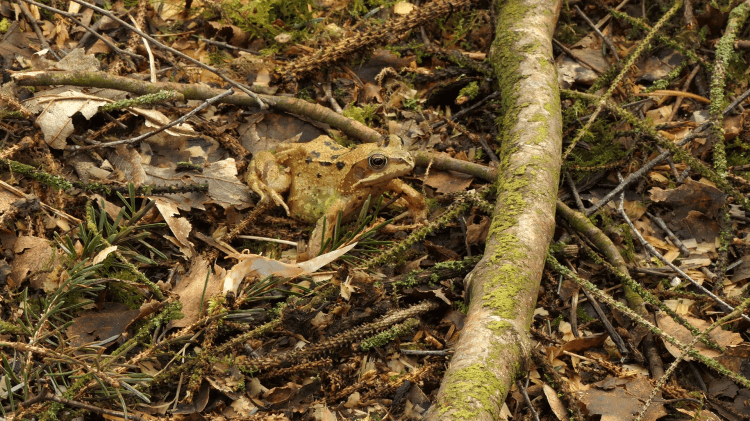
All around us, the volunteers are putting their shovels away. It’s time for a coffee and biscuit break. Before James helps me to find the exit of the reserve, one of the volunteers makes a discovery. On the ground, nearly invisible due to its colouring sits a frog. Several volunteers get their phones out and take pictures. “I hope he’ll make it,” says James as we leave the tree planting site and the dark shadows of the Sitka spruce behind us. “It can still be too cold for frogs at this time of the year.”


 backyard explorer